Yesterday, I went with my friend, Andy, to an Amish family farm to help them butcher some pigs. We arrived just after the pigs had been cleanly shot, in time to see the first pig being hoisted up off the ground by its feet while the second pig was being skinned on the ground.
I had never seen a slaughtered animal in person before, and it wasn't as bad as I had imagined. I didn't feel an outpouring of sympathy for the pigs, mainly because I knew they had enjoyed a good life and a quick, painless death on the farm rather than in a factory. The worst part was the smell -- a mixture of blood and pig scent that rose up in clouds of steam through the winter air. It was 22 below that morning, the Amish men said. A bit cold, but a nice day for butchering.
We did most of the skinning and disemboweling outside. One pig was quartered, another was halved. We then carried the parts inside for further disassembly.
I quickly got into a grove trimming off the layers of fat and removing meat from the bones. The fat looked like butter and it was incredibly soft. There was a lot of it, too; we filled up at least three, large stainless steel bowls.
I skinned one of the heads, removing the snout and ears. I had to ask for help with the eyes; they were held in their tight, and I was too squeamish to use my fingers to pry them out.
The heads went into a stew pot and would be used to make head cheese. The rest of the pigs were divided up between two Amish families, minus the four pork chops they sent home with me as a gift.
Throughout the process, I learned their is a fine art to skinning and butchering animals. The Amish were very skilled and made quick, elegant work of the animal sections they had. Andy and I were a bit clumsier, to say the least. But we learned as the day went on and, I hope, got a little better.
Even with six of us, it took us all day to cut up two pigs and a frozen deer. We didn't get to the sausage-making or preservation activities, although the entrails were washed out, scrubbed and made ready to be used as casings. The work gave me a new appreciation for hunters, butchers, and yeoman farmers who raise, slaughter, butcher and cook their own animals. These folks know where their dinner came from and are intimately familiar with the whole farm-to-table process.
Most city folks eat in ignorance and denial, not knowing -- and not wanting to know -- just how that pork chop came to be on their plate.
Wednesday, February 9, 2011

Friday, February 4, 2011
M State Professor Profile | Prieve and Wika
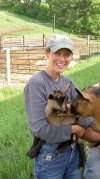 Dr. Tom Prieve, a veterinarian, and Dr. Sue Wika, a sociologist, are exemplary teachers, collaborators and farmers who respectively head the Equine Science and Sustainable Food Production programs at M State in Fergus Falls. They live on Paradox Farm where they raise performance Quarter horses, goats, chickens, turkeys, and geese.
 Dr. Prieve and Dr. Wika work well as a team both on their farm and at M State. Dr. Prieve brings a background in science and holistic veterinary medicine (he provides chiropractic and acupuncture treatments at Lake Region Veterinary Center). Dr. Wika brings her own experience with livestock as well as expertise in community-building and education. They each teach courses in the Equine Science and Sustainable Food Production programs, balancing for students scientific, social, and cultural perspectives on animal husbandry, agriculture, and ecology.
Their primary goal for Paradox Farm is to steward the native oak savannah and establish more perennial crops. As a first step, they introduced dairy goats to help with brush clearing. A local market for goat products encouraged Wika and Prieve to expand their herd and breed meat goat genetics into their dairy stock.
More recently, Wika and Prieve started custom-grazing cattle and expanding their perennial crops by planting a wide variety of fruit and nut trees.
Leveraging their knowledge of agroforestry and grass-based permaculture, Wika and Prieve are growing an edible forest to yield heirloom apples, cherries, apricots, plums, pears, Korean pine nuts, hazelnuts and other high-quality human foods. The tree crops also offer the potential for biofuel production and provide energy-dense animal feed, which could support pastured pigs and sheep in the future.
Dr. Wika started the Sustainable Food Production at M State to address “the social part of regenerative agriculture” – kindling excitement about farming and strengthening people's connection to nature.
Wika and Prieve emphasize both in the classroom and on the farm that observation and adaptability are key to sustainability and success. “We want to observe what the land is telling us, what the animals are telling us, and have that inform our planning.”
Future of Food
This week I watched The Future of Food documentary, which traces the rise of corporate control over our food supply, the disintegration and disenfranchisement of family farms, and the excessive efforts to keep the general public uninformed – or misinformed – about the story behind food.
Genetic engineering is the main example through which corporate control of food is examined. This “gene revolution” started in the mid-1990s and was endorsed by US Supreme Court, who declared in a watershed case that corporations not only have a right to patent genes, but that they also “own” any living thing that contains the patented genetic material.
Paradoxically, at the same time genetically modified foods were deemed unique enough to be patented, they were also declared “substantially equivalent” to foods created by selective breeding, placing them in the category of “generally recognized as safe” foods and exempting them from labeling requirements.
According the film, 80-90% of Americans want genetically engineered food to be labeled. Yet US government policies on genetically modified foods do not reflect the will of the people. The “Right to Know” act, drafted years ago, still has not been voted on by Congress. More disturbingly, neither the US Congress nor the US citizenry ever had the opportunity to vote on the issue of patenting life.
The film outlines how corporate control over food has been concentrated further by the consolidation of the pesticide and fertilizer companies with seed companies and the introduction of a terminator gene. Industrial farmers have little choice but to buy sterile seed every year from Monsanto or other large corporations along with the pesticides they more than coincidentally manufacture to be used with those seeds. Over time, the pesticides become less effective, and therefore more chemicals – or stronger chemicals – must be purchased from these corporations. The pesticides and fertilizers are doing damage to the environment and polluting water resources, but the farmers must continue to use them or risk losing their crops. The corporations thus benefit doubly from selling seed that can’t be saved and the chemical applications necessary for the seeds to grow.
Any farmer who wants to opt-out and grow his own seed is still at the mercy of Monsanto, since Monsanto can “take samples” from farms and claim that their patented genes were present in the crops. The law currently holds the farmer responsible for any unintentional or unknown contamination of his crops by patented genes. If the patented genes have penetrated the crops, no matter how they got there, it is the farmer’s responsibility to pay Monsanto.
Undeniably, it is very difficult to “fence out” genetically modified life forms. Life is designed to propagate itself and doesn’t easily “stay put.” Once genetically engineered strains are allowed outside the lab, they are impossible to control. Especially in our increasing interconnected global economy, genetically-modified organisms easily can contaminate and crowd out heirloom varieties, threatening biodiversity world-wide as well as people’s control over their food supply.
The good news is that the food industry is economically dependent on steady patronage from customers. And as awareness of the downsides of industrial food is spreading, so are sustainable farms. People now have more options for buying local food direct from farmers in lieu of industrially-produced products. This gives them power to “opt out” of the industrial food system and destabilize it with changed spending patterns. The catch is that a substantial number of individuals must band together in altering their food-buying habits for consumer power to have any material effect on the food system as a whole.
In the meantime, multi-national corporations have lots of money to throw at impression management. The film touched on just a couple of examples of how large corporations like Monsanto are manipulating people’s opinions and consumption patterns. For example, seed and chemical corporations are promoting their work as the key to ending global hunger. Advancing genetically engineered crops, they claim, is the only way to feed the world's growing population. The intimation is that resistance to genetically engineered crops is tantamount to condemning innocent people to death.
This rationalization of the value of genetically engineered food is just a duplicitous myth that prays on human emotion. As the film points out, people are not starving because there is not enough food. People are starving because they don’t have access to food. Globalized commodity crops have decimated small-scale, diversified subsistence farms. People who used to be able to grow their own food now have to get a job to purchase food – food which often is imported from the United States. Around the world, food choice and food sovereignty are being systemically assaulted in the supposed interest of “feeding the world.”
To combat this, all of us who are committed to advancing sustainable agriculture have to get just as skilled in impression management as the corporations. Our advantage is that we have a genuinely cogent, compelling story to tell with real facts, faces, and images to back it up.
Saturday, January 29, 2011
Back to Basics Conference
Today I went to a day-long conference organized by Happy Dancing Turtle called "Back to Basics for the Next 7 Generations." It was held in Pine River, MN -- about a two and a half hour drive from my home in Fergus Falls. It was well worth the trip.
Winona LaDuke was the featured keynote speaker. She gave approximately the same talk she gave to my Sociology of Agriculture class last week, but it was much more dramatic and touching the second time around. She emphasized the importance of food sovereignty -- the right to grow one's own food in a sustainable, ecologically and socially responsible way. She also underscored the value of "plugging the leaks" in our economy and resource usage, by reducing waste, keeping money local (i.e. patronizing local businesses), and decreasing our reliance on "job growth" by increasing our abilities to meet our own needs on a local, community level. Finally, she reminded us that a nation's GDP has no correlation to its citizens' happiness or well-being. "What can be measured doesn't count, and what counts can't be measured."
I attended sessions on how to make hooked rugs, how to grow mushrooms, how to raise animals for food, and how to leverage the medicinal value of herbs. All were fabulous, but the one that was most significant for me today was the session on raising animals for food.
I have been struggling with trying to decide what type of farm enterprises I'd like to have -- once I've graduated from the program and gained a little experience. We're supposed to be writing a business plan in my Farm Management class, and when writing a business plan, it's helpful to have particular products in mind. Well, deciding what to produce on a farm is not easy! I've been researching everything from cashmere goats to meat rabbits to wine to cider to grass-fed beef to bees and berries. It gets overwhelming. There are so many options!
The session on raising animals for food was very helpful in helping me refine my vision. I learned that chickens and turkeys tend to die easily, and that ducks are much easier to raise. I learned that yaks drink much less water than cattle, need less space, and tend to have good personalities. I also learned that rabbits are the most efficient converters of vegetation to meat. But the main value of the session was that the obvious finally started to sink in: don't raise animals you don't like, and don't grow food you don't like, regardless of the potential for economic profit.
I had been considering pastured broilers, because the demand for chicken is very high and the profit margin is decent. But I don't like broilers -- either as animals on a farm or as food on my plate. So scratch that.
What I always thought I would never want to do -- grow vegetables -- is now looking like a really good option. I like to eat vegetables, and growing them would reduce my produce bill. Also, I could use ducks to weed and add fertility, and I could raise some Angora rabbits on grass and unmarketable produce. Add some Shiitake mushrooms on oak logs, and it turns into a pretty viable operation for me.
So I have my first realistic vision: a veggie farm with ducks, rabbits, and mushrooms. Now if I could just have Cashmere goats as draft animals to do the tillage...
Winona LaDuke was the featured keynote speaker. She gave approximately the same talk she gave to my Sociology of Agriculture class last week, but it was much more dramatic and touching the second time around. She emphasized the importance of food sovereignty -- the right to grow one's own food in a sustainable, ecologically and socially responsible way. She also underscored the value of "plugging the leaks" in our economy and resource usage, by reducing waste, keeping money local (i.e. patronizing local businesses), and decreasing our reliance on "job growth" by increasing our abilities to meet our own needs on a local, community level. Finally, she reminded us that a nation's GDP has no correlation to its citizens' happiness or well-being. "What can be measured doesn't count, and what counts can't be measured."
I attended sessions on how to make hooked rugs, how to grow mushrooms, how to raise animals for food, and how to leverage the medicinal value of herbs. All were fabulous, but the one that was most significant for me today was the session on raising animals for food.
I have been struggling with trying to decide what type of farm enterprises I'd like to have -- once I've graduated from the program and gained a little experience. We're supposed to be writing a business plan in my Farm Management class, and when writing a business plan, it's helpful to have particular products in mind. Well, deciding what to produce on a farm is not easy! I've been researching everything from cashmere goats to meat rabbits to wine to cider to grass-fed beef to bees and berries. It gets overwhelming. There are so many options!
The session on raising animals for food was very helpful in helping me refine my vision. I learned that chickens and turkeys tend to die easily, and that ducks are much easier to raise. I learned that yaks drink much less water than cattle, need less space, and tend to have good personalities. I also learned that rabbits are the most efficient converters of vegetation to meat. But the main value of the session was that the obvious finally started to sink in: don't raise animals you don't like, and don't grow food you don't like, regardless of the potential for economic profit.
I had been considering pastured broilers, because the demand for chicken is very high and the profit margin is decent. But I don't like broilers -- either as animals on a farm or as food on my plate. So scratch that.
What I always thought I would never want to do -- grow vegetables -- is now looking like a really good option. I like to eat vegetables, and growing them would reduce my produce bill. Also, I could use ducks to weed and add fertility, and I could raise some Angora rabbits on grass and unmarketable produce. Add some Shiitake mushrooms on oak logs, and it turns into a pretty viable operation for me.
So I have my first realistic vision: a veggie farm with ducks, rabbits, and mushrooms. Now if I could just have Cashmere goats as draft animals to do the tillage...
Thursday, January 27, 2011
Grazing Cattle
 Today in my grass-based livestock class, we learned how to calculate the size of paddocks for specific herds. We also watched videos of cattle in different grazing situations.
I realized just how much I've learned this year when I could identify Jerseys and Holsteins in the herd. These are common, easily-identifiable breeds to be sure -- no farmer would be impressed that I could identify them. But for a city girl who one year ago didn't know what a heifer was, I think it's an accomplishment.
It's amazing to me how much knowledge I've gained in the Sustainable Food Production program -- knowledge that many rural folks take for granted and that most city dwellers don't know exists.
For example, figuring out how to feed cattle (in a grass-based system) is tremendously complex. If they are being rotationally grazed, you have to factor in the weight of the cattle, their nutritional requirements ("dry cows" don't have as many needs as lactating cows), the forage species on your pastures, and the state of growth of your pasture's species.
A herd of 25 stocker calves, we figured out, might need about 2/3 of an acre of pasture per day in June, while in August, they might need two times that amount of space, depending on how tall the grass is.
In addition, before you can "re-graze" a paddock, you have to allow for adequate rest. How long of a rest period is needed? Well, that depends on the species you have, the time of year, the weather, the health of your soil, etc.
Calculating how much pasture a herd of cattle need (and where to put up the temporary fences) reminded me of math problems on the GRE and SAT. (Good math skills are critical for a grass-based livestock farmer!) I can't imagine doing these types of calculations every day, not knowing what the variables will be tomorrow or next week.
Take-home lesson: managing a herd of cattle on pasture is far more difficult than most people can imagine. Now I understand why the farmers we've visited said it takes about 3-5 years to learn how to graze successfully!
Tuesday, December 14, 2010
Methods of Castration
Farm animals, I learned on a recent visit to Seven Pines farm, can castrated without any sedative or painkiller. It is done when they are young – as young as possible – and it can be done without a vet. The only tools needed are a scalpel (or other castrating tool) and an iodine solution to spray on the wound.
Also, there are a couple different methods of castration. Some involve removing the testicles; some involve just severing the spermatic cord.
Male mammals have two testicles and two spermatic cords. The spermatic cords in a calf are very “tough” and can be easily felt through the scrotum. They feel like a wide tendon. When castrating a calf, it's important to cut both of these cords WITHOUT cutting the central artery that runs down the middle of the scrotum. The artery is smaller than the cords and feels like a very thin, fragile tendon.
At Seven Pines, our class castrated a bull calf by cutting “slits” in the bottom of each side of the scrotum, then “pulling out” the testicles and cutting the spermatic cords.
We also castrated several pigs, which was more difficult. The pigs' testicles are “inside” their body cavity; they do not hang outside as the calf's do. To castrate a pig, one person hangs on to the pig's feet and holds it upside down, with the pig's head trapped between the person's legs and the pig's stomach facing “out” towards the castrator. The castrator takes a scalpel and makes a cut between the pig's legs. Then, the castrator removes the first testicle by “popping it out” manually and cutting the cord. Next, the castrator has to make a slit into a membrane (using the first cut as the point of entry) and dig out the second testicle. The second testicle is “popped out” by strategic poking and pushing, and then it is pulled out far enough for the cord to be cut.
Sometimes, if it is difficult to find the membrane to cut, a second incision needs to be made between the pig's legs in order to find and dig out the second testicle.
Although it looked (and sounded) like a horrible process to me as a city girl and animal lover, the pigs recovered quickly. After we set them down, they were walking and running around like normal.
Animal Husbandry at Seven Pines
Seven Pines is a grass-based dairy farm owned by one of my professors, Kent Solberg, and his wife Linda. In addition to dairy cows, they also have pigs, laying hens, and bull calves.
On November 5th, our class visited Seven Pines for the second time to learn about castration. We started by listening to Dr. Tom Prieve (a veterinarian and one of our professors) explain several methods of, and tools for, castration. Then, we castrated about a dozen young barrows and one bull calf. We also watched Dr. Prieve do pregnancy checks on several heifers and treat the foot of another. Finally, we took a pasture walk with Kent, checking in on his dairy herd grazing the neighboring corn and soybean field.
Visiting Seven Pines for the second time, I noticed more about Kent and Linda's approach to farming. Specifically, I observed the tenderness they showed their animals and their focus on responsible stewardship.
When we walked over to the calves in fenced-in circles, Linda introduced the calves by name. “This is Sven,” she said. “We're thinking of keeping him as a breeding bull.” Another bull calf, Zeke, we were there to castrate. However, while trying to wrangle him from the fenced circle, he escaped out the back. Stephanie and I gently coaxed him back towards the group. He didn't seem to be afraid of people and handled the castration quite well – no yelling or kicking.
Kent and Linda's cattle all appeared to be very tame. When Dr. Prieve did pregnancy tests and examined one cow's foot, Kent was able to get the heifers in the holding frame by just calling their names and walking with them in the right direction. He was gentle with them; no paddles or electric prods, like I had witnessed at a larger farm that Dr. Prieve visited to do pregnancy tests a couple weeks ago.
Some of the calves were set apart from the herd, because they appeared sickly after a rain. Linda said they needed special monitoring and attention. I felt like their care of these cattle came from a place of empathy and love; the calves were not simply “investments,” they were living beings with personalities and names.
When we went to castrate the piglets, Kent secured the mother hogs in a trailer. They were hollering, and Kent said to them, “yes I know you're mad,” in an understanding tone. He did not complain about them at all, but rather complemented them on being great mothers. After we were done with the castration, he let out the hogs saying “go comfort your babies.” The mother hogs did not appear aggressive after being penned up, as some hogs might; they seemed tame and relatively mellow. Some actually went back into the trailer to sniff around. Kent kept urging them to go see their babies, and eventually they did. The hogs seemed to trust Kent; or at least, they were familiar with him and did not consider him to be any kind of threat.
While the pigs were being castrated, Dr. Prieve handed a baby gilt to me and said she needed comforting. This seemed perfectly natural in the context of Seven Pines; comforting gilts seemed in keeping with Kent and Linda's approach to farming.
The way Kent and Linda talked to, and about, their animals, was gentle and caring. They seemed to think of the animals as an important, contributing part of their farm who deserved care and respect. The animals were not treated as “property,” but as dedicated workers or family-member employees.
Before we left, Linda offered us homemade pumpkin bars, and Kent invited us to come back individually, spend the night, and experience milking. This hospitality went far beyond “educating students on business practices.” Kent and Linda genuinely care about community, relationships, and nurturing a new generation of farmers.
Subscribe to:
Posts (Atom)